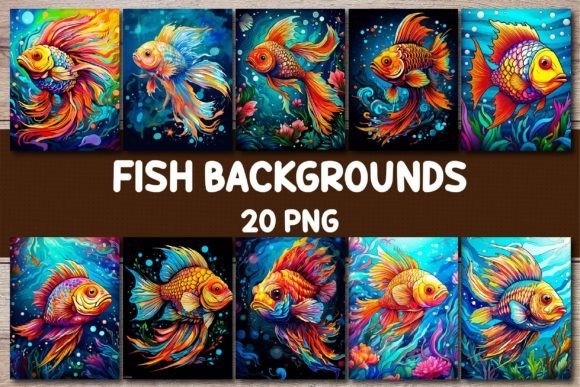
Transform Your Projects with Fish Backgrounds for Covers
In the crowded landscape of digital publishing and design, capturing attention in a split second is the ultimate challenge. Whether you are a seasoned graphic designer, an independent author launching on Amazon KDP, or a content creator looking for fresh visual assets, the background sets the stage for your entire project. It is the canvas upon which your message is built. While solid colors and geometric patterns have their place, nothing quite compares to the organic, fluid beauty of nature. This is where the specific utility and aesthetic power of Fish Backgrounds for Covers come into play, offering a unique blend of tranquility and visual complexity that is hard to replicate with standard design elements.
The Visual Language of Aquatic Design
When we talk about "Fish Backgrounds for Covers," we aren't just referring to random snapshots of fish. We are discussing a curated collection of digital paper and design assets specifically crafted to evoke a sense of underwater serenity. The visual characteristics of these backgrounds are distinct. They often feature intricate line work, vibrant color palettes ranging from deep ocean blues to tropical neons, and a sense of depth that draws the viewer in.
The personality of this style is inherently calming yet dynamic. It balances the stunning book covers aesthetic with a sense of movement. For a designer or brand strategist, this offers a versatile tool. The "style" is often illustrative, making it perfect for coloring book covers, but high-resolution photography styles are also prevalent for more realistic branding needs. The appeal lies in its universality; the ocean is a universal symbol of depth, mystery, and life. Using these backgrounds immediately communicates a message of richness and detail, signaling to the viewer that the content within is worth exploring.
Strategic Applications for Designers and Publishers
Understanding where to deploy Fish Backgrounds for Covers is just as important as the assets themselves. For the Amazon Kindle Direct Publishing (KDP) community, these assets are invaluable. A KDP Interior or a KDP Coloring Book requires a cover that pops on a thumbnail-sized digital shelf. The intricate patterns found in fish designs naturally scale well, maintaining their visual hierarchy whether viewed on a massive desktop monitor or a small smartphone screen.
Beyond the publishing world, these backgrounds serve a wide array of creative professionals:
- Brand Identity: Small businesses in the wellness, spa, or sustainable seafood industries can use these textures to build a cohesive brand identity. The imagery suggests purity and nature, which is excellent for building trust.
- Packaging Design: If you are designing for a product that needs to stand out, a textured aquatic background adds a tactile feel to digital mockups. It moves the design away from sterile minimalism into something more organic.
- Social Media Graphics: Content creators often struggle with finding consistent backgrounds for Instagram or Pinterest. A set of 20 matching fish designs provides a month's worth of cohesive content, ensuring your grid looks professional and curated.
- Editorial Design: Magazines or blogs focusing on travel, biology, or mindfulness can use these as section dividers or full-bleed background images to break up long blocks of text.
Impact on Audience Engagement and Perception
The choice of background influences how an audience perceives the quality of your work. A pixelated or generic stock image can cheapen the perceived value of a premium product. Conversely, a high-quality, 300 DPI image with professional composition elevates the entire project. When you use a Fish Background for Cover, you are leveraging a psychological trigger known as biophilia—the human tendency to seek connections with nature.
This connection impacts audience engagement significantly. A viewer is more likely to pause on a social media post or click on a book cover that offers a visual break from the artificial, digital noise of the internet. The "serenity" mentioned in the collection's description isn't just a buzzword; it is a functional design outcome. By reducing visual clutter and offering a harmonious color palette, you facilitate a better user experience. This is particularly relevant for products marketed for stress relief or mindfulness. If your product promises relaxation, the cover must visually deliver that promise before the customer even opens the book.
Practical Guidance for Implementation
Integrating these assets into your workflow requires a practical approach. First, consider the visual hierarchy of your project. A fish background is often complex. If you are laying text over it, you need to ensure readability. This is where design principles like contrast and typography come into play. You might need to place a semi-transparent overlay between the background and your display font to ensure your title pops.
Speaking of typography, font pairing is crucial here. Because the background is organic and fluid, it pairs well with a variety of typefaces, but the contrast is key.
- Modern Typography: A clean, geometric sans serif font can provide a striking modern contrast to the organic fish shapes, creating a "tech-meets-nature" vibe perfect for eco-tech startups.
- Classic Elegance: A sophisticated serif font or a flowing script font can enhance the traditional beauty of the aquatic imagery, making it ideal for high-end invitations or luxury brand stationery.
- Playful Creativity: A handwritten font works exceptionally well for children’s books or casual lifestyle blogs, keeping the tone friendly and approachable.
When evaluating the fit of the Fish Backgrounds for Covers bundle for your specific needs, look at the included styles. A bundle offering 20 designs provides variety—some may be dense line art suitable for adult coloring books, while others might be softer watercolor washes suitable for poetry collections. Always test your design on multiple devices. What looks like a subtle texture on a high-resolution monitor might become a noisy distraction on a mobile screen.
Finally, consider the licensing and file formats. For professional use, specifically for Amazon KDP or commercial print, the file format matters. PNG files are essential because they support transparency and lossless compression. This ensures that when you overlay your text or combine the background with other graphic design elements, the edges remain sharp and the colors remain true. This attention to technical detail separates amateur projects from professional, high-quality publications.